
|
Now the dust has finally settled on London 2012, Martin Benke, operations director at Airwave, provider of critical voice and data communications to public service organisations in Great Britain, has the time to reflect on one of the busiest periods in the company’s history. Airwave was contracted in June 2008 to build and operate a TETRA service by the London Organizing Committee of the Olympic and Paralympic Games (LOCOG) to cover all the Olympic venues and the Olympic route network. As well as this, it upgraded the existing Airwave TETRA network for emergency services in and around the games venues. “The first thing we did was we upgraded the ‘blue-light’ network”, Martin explains. “There were more police in London than at any time previously. There were events going on in Dorset with the sailing, the rowing at Eton Dorney, mountain-biking out in Essex, football held across the country. A total of 34 different venues were looked at for upgrading the blue-light network.” This upgrade involved bringing in some new features on to the network. “We introduced the capability to add more users under a single base station than ever before”, Martin continues. “Previously the limit was 2000, now the limit is 2500. This gave us the capability to have more police officers sitting at a single point without the risk of congestion on the network.” The company also upgraded the base station sites to support 10 base radios, something Martin claims no other network in the world can offer. “It provided us with a secondary control channel”, he said. “Previously capacity on the base station was restricted by the fact there was only one control channel. With the upgrades we now have multiple control channels. All these features were being used for the first time in the world.” Additional ports were added to five police control rooms and a number of special coverage solutions were put in place. There was also a request from LOCOG to put in enhanced support arrangements, which meant that during the Games the fix time reduced from the standard four hours down to two hours. The Apollo networkThe next challenge was to build a separate TETRA network, called Apollo, for the organizing committee to use themselves. This provided communications for the 200 000 members of staff and volunteers at the various venues around the country. “It wasn’t just building a network”, Martin explains. “We were responsible for the complete end-to-end service. We were responsible for making sure all the volunteers, the games makers, had their terminals, the security staff had their terminals and we were responsible for the provision of all that equipment, getting it to them and making sure it was the right sort of equipment. “We got the network ready for service well in advance of the Games. That was pretty typical of the preparation for lots of things – there wasn’t too much left until the last minute. It was ready throughout the test events that went on in the summer of 2011.” These test events gave the company the perfect opportunity to put the network through its paces and sort out any issues. “We had a series of exercises where we came up with a number of different scenarios. We had three specific war-gaming sessions and two driven by our customers as well, so we were thinking of all the things that could go wrong. “Our chief executive’s advice to us was: think of the worst thing that could happen, and then multiply it by 100. You haven’t got one engineer stuck in traffic, you have 100 engineers stuck in traffic. How are you going to deal with it?” Because of access and security considerations, they chose not to build sites within the Olympic Park itself. Martin continues: “We did a macro-based solution, firing coverage into the park. That meant we had easy access to the sites as we didn’t have to go into the secure area, and it also gave us the flexibility to not be constrained by all the development going on in the park. Find a nice tower block next to the park and get it all ready while they’re still building stuff in the park. “We employed a lot of macro sites; we did put in some temporary sites specifically for the road cycling. For the road cycling we also had an aerial solution to provide coverage for the stewards. We dropped 20 cabins – in Hyde Park, at Lord’s and so forth, to provide pseudo-temporary solutions just for the events.”
|
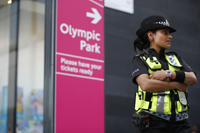 This summer’s Olympic Games in London proved hugely successful for both the British team and the organizing committee. David Taylor discovers how staff at UK