
|
For a start, it’s important for you, as a foreigner, to understand that you are now in a country with 324?000 square kilometres and a population a little below five million”, begins Tor Helge Lyngstøl. “That makes the implementation of a nationwide radio network quite a huge investment per capita. “So I think this is one of the main reasons why it has taken some time in Norway.” Mr Lyngstøl is the director of DNK, the Norwegian Government’s directorate for emergency communications, where he is responsible for a large TETRA project now entering its main deployment phase. It’s a national roll-out which will put in place up to 2000 base stations nationwide by 2015, bringing a shared digital radio communications platform to 40?000 or more users in the emergency services and numerous other bodies. It will be Norway’s biggest ever investment in public protection. “One might say that we are not completely out of money in Norway”, Mr Lyngstøl continues, delicately. “But we are talking about a life-cycle cost of about 10 billion NOK here. The state budget in Norway for 2012 just passed 1000 billion NOK. “In the investment phase that we are in now, the investment cost – when you include the internal cost to the State – will be approximately six billion NOK, and that is more than $1 billion. It is quite a huge investment.” Norway’s Nødnett (‘Emergency Network’) project began with a pilot system serving just the Oslo region – a small area which nonetheless is home to 30 per cent of Norway’s population. This pilot became the subject of exhaustive official reviews and evaluations. But with an ambitious programme so very visible on the state budget, it is perhaps no surprise that a three-year delay ensued before Parliament finally gave the go-ahead for nationwide deployment. However, a few weeks after that decision was made, Norway was shaken by the horrific events of July 22, 2011 – a terrorist car bomb explosion outside the offices of the Prime Minister, killing eight people and wounding others, followed by a gunman’s attack on an island summer camp, in which 69 lives were taken. These shocking disturbances to an otherwise peaceable society shifted public opinion by underlining the need to equip the emergency agencies with the ability to deliver a fast and efficient response. “It became very clear that Nødnett will contribute to a safer society for all”, comments Mr Lyngstøl. “This is of course a thing you can say in speeches – but we experienced this, and this is important.” Multi-agencyPlans for the system have included some special features. For one thing, a multi-agency approach has been taken from the start. Police, fire and health services, the three core users, have been extensively involved in drawing up the specifications, in the evaluations and the discussions surrounding the contract. A complex network of stakeholders has fed in requirements and opinions. Control rooms are also part of the project, and dozens of new ones will be provided for the various agencies. Furthermore, Nødnett is the first TETRA project to embed in its contract a TEDS overlay – a TETRA 2 technology designed to deliver high-speed mobile data. DNK’s responsibilities extend to the radio network, the core network, the control rooms and operation of the network, and also the supply of radio terminals. Contractor for the project is Nokia Siemens Networks, which has brought in Motorola as its subcontractor for the radio side of the deployment, and Frequentis as supplier of the control room systems. Target date for completion of the network is 2015 – which will mean a very fast roll-out. “I like to say we are building this network for two purposes: for a normal situation, and for an extreme situation”, Mr Lyngstøl continues. But he admits: “What happened on 22 July was even a little bit more extreme than we had planned for.”
Besides managing contractors, DNK has also had to grapple with funding arrangements for the various user organizations and other stakeholders. While the State will pay for construction, users must bear their own operational costs. One tricky case has been the fire service, for which performance standards are laid down by the Directorate for Civil Protection, yet the money is provided, sometimes reluctantly, by municipal authorities. “It is a requirement from the State that they use the network”, Mr Lyngstøl emphasizes. “Of course they will complain about what they have to pay for it, but there isn’t a choice to stay out.”
|
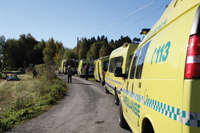 Norway’s