
|
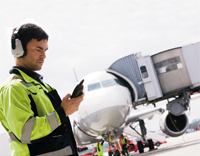
There’s long been a close relationship between aviation and wireless communications. At around the same time that mankind was physically taking to the air through the first attempts at fixed-wing flight, so too were the pioneers of radio exploring ways to control the airwaves. Since those first stumbling steps – amazingly only a little more than a century ago – that intimacy has grown as each sector went on to shrink the world in its own particular way. The role of wireless in the actual air is familiar enough to all of us through countless disaster blockbusters involving stressed air traffic control staff and heroic pilots. By contrast, there’s far less understanding of what goes on in the realm of radio when the aircraft touches down on the ground and a multitude of more mundane – but just as vital – processes goes into action. In today’s lean, asset-sweating times, aircraft must be turned around as quickly as possible – and that involves choreographing a complex dance of behind-the-scenes activities to get the aeroplanes fuelled, cleaned, restocked, crewed and maintained. Meanwhile, inside the terminal, passengers and personnel must be marshalled in just as efficient a way, informed and directed through the various choke-points and checkpoints to arrive – hopefully – without delay to either themselves or the airport’s other operations. Until the arrival of TETRA on the aviation scene, synchronizing all these activities in a smooth and seamless way was challenging, to say the least. All the different companies and entities involved – from fuel tanker drivers to airline check-in staff – used different communications methods, radio systems and frequencies. The complexities and inefficiencies implicit in such a fragmented infrastructure – impacting everything from spectrum availability to operational efficiencies and staffing levels – called out for a single integrated approach to airport communications. As increasing numbers of airports around the world are now finding out, Tetra offers just such an infrastructure – and one that rapidly recovers the costs involved in deployment and training. Public safety rootsAs Phil Godfrey of the TETRA Association explains, TETRA’s history have made it an ideal fit for such a challenging environment. “After some early projects, the aviation sector has really taken off for TETRA just in the last four or five years”, he says. “Its public safety origins have made it a very well suited for the kinds of mission-critical applications that you find in the aviation ground environment – even if most of those applications are commercial rather than emergency-oriented, the safety of the travelling public and staff remains paramount. “TETRA’s ability to support the dynamic grouping and interaction of different communities means that resources can be quickly allocated to specific operations such as baggage handling, catering, de-icing and so on. Other integral TETRA capabilities – such as GPS in terminals and encryption – enhance operational efficiencies even further.” Operating in an airport environment also places additional heavy demands on the radio infrastructure and terminal equipment when it comes to dealing with the noise – both electronic and aural – and the complexities Alan Dowen, international business development manager at the TETRA infrastructure specialist Artevea emphasizes, “One key advantage of TETRA in a busy and noisy environment involves the codec compression and decompression ratio, so voice is clearer to the receiving party than the background noise picked up in analogue systems. “Radio surveys are essential and it can be necessary sometimes to provide coverage in tunnels, basements and high-density buildings, and for these a distributed antenna systems (DAS) and/or radiating cable may be necessary. Feeding such a DAS could employ direct co-ax cable from the base station, a cell enhancer, a fibre-optic repeater station or a dedicated base station – depending on cost, distance and type of building to be served.” He continues: “When you’re looking at the actual applications areas and groups in an airport, these would typically include aircraft arrivals and departures, customer check-in, engineering activities, baggage handling and security. In addition, you also have the various groups that would be involved in the event of an emergency, such as aircraft evacuation, incidents in the terminal buildings, unscheduled aircraft arrivals and departures and military operations.”
|
 For mission-critical ground communications at busy airports, radio systems based on